
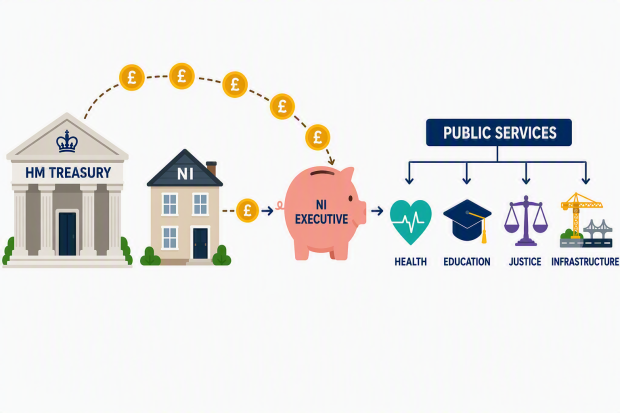
The NI Executive is responsible for delivering a wide range of public services, including health, education, justice and infrastructure. Funding for these services comes predominantly from the UK Government, making NI more reliant on Westminster funding than either Scotland or Wales. Although the Executive has some devolved tax and revenue-raising powers, these are relatively limited and several available levers have not been used. This article explains the main sources of funding available to the Executive, the reasons for NI's dependence on UK Government support, and how resources are allocated across departments.
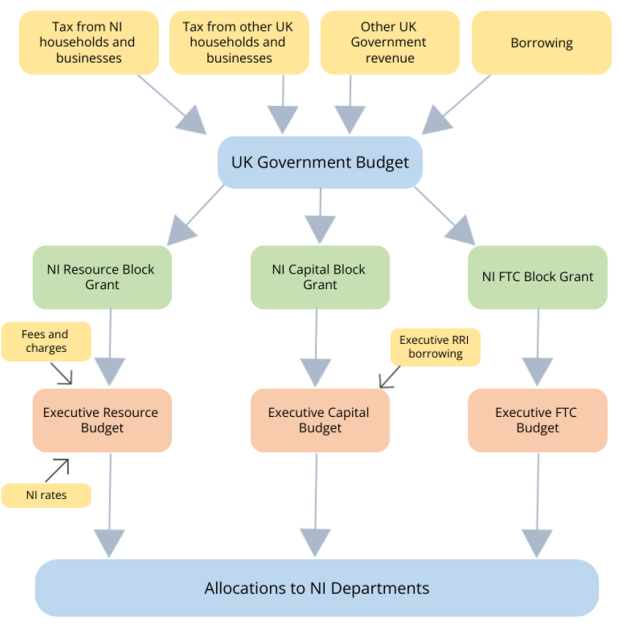
The Executive's budget can be divided into three broad types of Departmental Expenditure Limit (DEL):
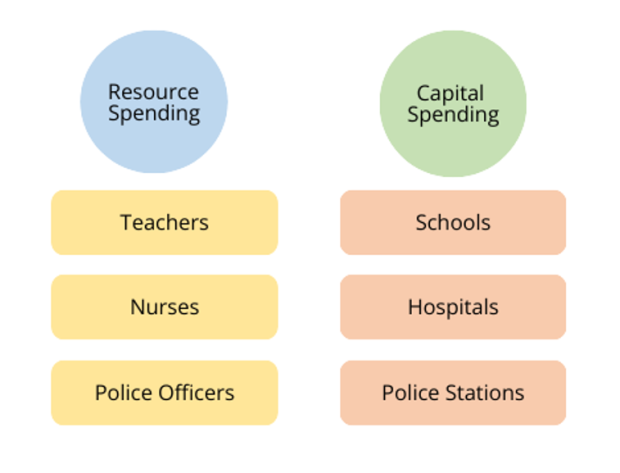
- Resource spending, which funds the day-to-day delivery of public services. This is the largest category and where budgets are usually under most pressure.
- Capital spending, which finances long-term investments in public services, such as infrastructure for schools, hospitals and roads; and
- Financial Transactions Capital (FTC), a relatively small budget, which can only be used for loans to and equity investments in private and third sector entities.
The Executive relies heavily on funding from the UK Government to finance each of these types of spending. In 2025-26, the Block Grant from Westminster totalled £18.8 billion and accounted for roughly 93 per cent of the Executive's total DEL funding. The remaining £1.3 billion (7 per cent) was raised locally from domestic and non-domestic rates (£0.7 billion - 4 per cent), plus RRI borrowing (£0.2 billion - 1 per cent) and a Reserve Claim from the Treasury (£0.4 billion - 2 per cent). In addition, £0.7 billion raised from fees and charges was retained by departments and used to offset further resource expenditure.
We focus on DEL budgets rather than Annually Managed Expenditure (AME) here because the AME financing arrangements are outside the Executive’s budgeting processes
This reliance on UK Government funding means that spending decisions taken in Whitehall have a bigger influence on the evolution of NI's public finances than local decisions on revenue raising. A clear understanding of the funding system is essential when assessing the fiscal challenges and budgetary pressures facing the Executive.
Like the spending of UK Government departments, the Block Grant to the Executive is funded through UK-wide taxation, other revenue and borrowing. Since 1979- 80, changes to the Block Grant from one year to the next have been determined largely through the Barnett Formula, which provides NI with a population-based share of changes in spending by UK Government departments on comparable services in England. These adjustments are referred to as ‘Barnett consequentials’.
The Statement of Funding Policy sets out the rules governing how funding is allocated to the devolved administrations. It includes the comparability factors used in the Barnett Formula, which determine the extent to which changes in spending by UK Government departments in England generate Barnett consequentials for NI. A higher comparability factor results in a larger consequential, while a lower factor reduces the impact on the Block Grant. See further details in our Guide to NI public finances.
In addition to the core Barnett-adjusted Block Grant funding, the Executive has periodically received additional Block Grant funding through UK Government initiatives (like City and Growth Deals), as well as political agreements and ad hoc financial packages negotiated between the UK Government and NI political parties. Examples include the New Decade, New Approach agreement and the financial package accompanying the restoration of the Executive in 2024. This funding is typically time-limited and earmarked for particular purposes. In 2025-26, non-Barnett Block Grant funding was around £1.3 billion and paid for around 7 per cent of total departmental expenditure in NI.
The Executive is considerably more reliant on UK Government funding than the other devolved administrations. Around 95 per cent of its funding is provided through the Block Grant, compared with roughly 80 per cent for the Welsh Government and 60 per cent for the Scottish Government. As a result, changes in UK Government spending decisions have a proportionately greater impact on NI's public finances. Scotland and Wales both have a wider range of devolved tax powers – notably over income tax and property transactions taxes – allowing them to finance a greater share of their spending locally. NI's own revenue sources are comparatively limited, which means that changes in UK Government spending that impact the Block Grant are particularly important in determining the available funding of NI public services.
Where does the money go?
Resource Spending
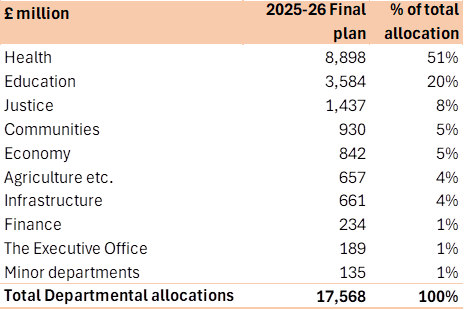
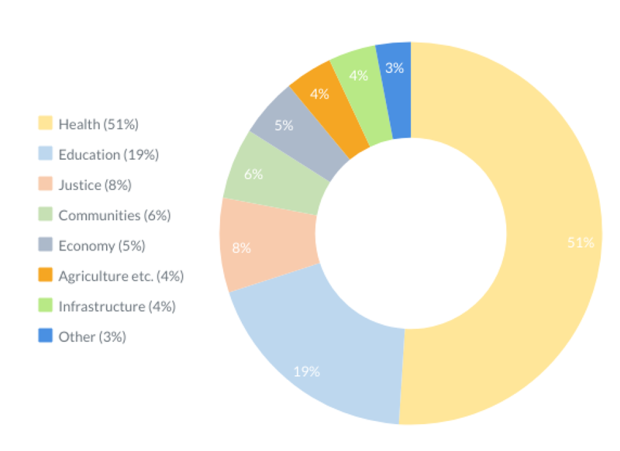
Resource spending finances the day-to-day delivery of public services. Health accounts for around half of departmental resource spending, making it by far the largest area of expenditure, followed by Education and Justice. Because resource budgets fund frontline services directly, changes in funding can have immediate implications for service delivery, staffing and departmental budgets.
How Does the Barnett formula help determine funding?
When the Barnett formula was introduced in 1979-80, NI’s higher spending per person than in England at the time was built into the initial baseline. The formula now determines changes to NI's baseline Block Grant by providing a population-based share of changes in comparable public spending in England. When expenditure on devolved services increases or decreases in England, NI receives a proportionate adjustment through Barnett consequentials. In effect, this means that when the UK Government increases spending in England on a service for which the Executive is responsible in NI, the Block Grant increases by an equivalent amount in pounds per head of population.
Historically, spending per person in NI (and in the other devolved administrations) has always been higher than in England, partly reflecting the higher cost of delivering comparable public services (and the UK Government has long accepted that this should be the case.) Higher levels of deprivation, demographic pressures and a more dispersed population all contribute to greater spending need. Our best estimate is that NI requires spending per head of around 124 per cent of the English level to provide an equivalent standard of public services, but different judgements produce different estimates.
Spending per head in NI is currently pretty close to this level of relative need. But, in its basic form, the Barnett Formula will erode the spending premium over England with time, as increases in the core Block Grant match changes in the UK Government spending per person in cash terms rather than percentage terms. To help ensure funding remains reasonably well aligned with this level of need, the 2024 Interim Fiscal Framework agreed between the Executive and the UK Government, to introduce a needs-based adjustment that is applied when NI's funding falls below the 124 per cent threshold. In that situation, it tops up future Barnett consequentials by 24 per cent.
Revenue Raised Locally
Although the Block Grant is the dominant source of funding for the Executive, as noted above it also raises some revenue within NI to help finance its resource spending.
The most significant locally raised revenue comes from domestic and non-domestic rates. The Executive sets a regional rate, while NI's local councils levy their own district rates. In addition, departments charge for services they provide, such as planning applications, vehicle testing, college tuition and court fees. Modest though these amounts are next to the Block Grant, this locally raised income is far from trivial: funding services that would otherwise fall to an already-stretched Block Grant.
While the Executive has fewer devolved tax powers than either Scotland or Wales, they have some control over income tax and greater control over taxes such as property transaction taxes and landfill taxes.
Capital Funding and Borrowing
Capital spending is funded through a combination of Block Grant allocations and borrowing. Although capital budgets are much smaller than resource budgets, they are important because they influence the long-term quality and capacity of public services.
Borrowing takes place through the Reinvestment and Reform Initiative (RRI). This allows the Executive to access loans via HM Treasury to support infrastructure projects such as schools, hospitals, roads and other public assets.
The RRI is subject to annual limits agreed with HM Treasury. That limit is currently £225.7 million in 2025-26, rising each year in line with inflation within an overall statutory ceiling of £3 billion, and cannot be used to finance day-to-day spending.
Consequently, borrowing can help address infrastructure needs but does not resolve underlying pressures in resource budgets. Indeed, if borrowing is used to finance new capital investment this may increase pressure on the resource budget by adding new running costs and debt interest payments.
Financial Transactions Capital
The Executive also receives Financial Transactions Capital, a distinct form of funding that can only be used for loans to and/or equity investments in private and third sector entities, rather than for public services or grants. This is because it is repayable to the Treasury. It is generally used to support housing schemes, third sector investment and higher education projects. Because of the restrictions, departments (in Scotland and Wales as well as NI) have found FTC difficult to spend, as suitable projects are often limited compared with demand for conventional resource and capital funding.
Why Do Funding Sources Matter?
Understanding how the Executive is funded helps explain many of the pressures facing NI's public finances.
Because the Block Grant provides the vast majority of NI's funding, decisions taken by the UK Government have a significant influence on the Executive's budget. At the same time, the Executive's ability to generate additional revenue locally is constrained by limited revenue-raising powers and, in some cases, by decisions not to use fully those powers that are available.
Local control is not simply a question of which powers the Executive possesses, but also of how far it chooses to exercise them. For example, the Executive has chosen not to introduce domestic water charges, to maintain a comparatively low regional rate, and not to vary corporation tax. These are legitimate policy choices, but each has a fiscal consequence: revenue that is not raised locally must either be found elsewhere or results in less funding being available for public services.
In short, while NI's funding position is shaped largely by decisions taken elsewhere, the Executive also has relatively few fiscal levers of its own and has shown limited appetite to make full use of those that already exist. This combination of high dependence on external funding and limited local revenue generation leaves the budget particularly exposed when spending pressures intensify.
Recent years have demonstrated how vulnerable departmental budgets can be to wider economic trends. Inflation, public sector pay demands and increasing demand for public services have all placed pressure on spending plans, especially when changes in UK Government spending to finance pay deals do not generate sufficient resources through the Barnett Formula to deliver equivalent percentage pay increases in NI.
The structure of the Executive’s funding therefore underpins the public discussion of public service reform, fiscal sustainability and the future financing of devolved governments. Understanding where funding comes from is an important starting point for understanding the broader challenges facing NI's public finances today.