

Is Northern Ireland fairly funded? This is the question behind almost every argument about Stormont’s budget, but the answer depends on what you regard as fair.
This article sets out to do three things. First, explain in plain terms how NI’s funding is worked out, and why the Barnett Formula has slowly eroded NI’s spending advantage over England — the ‘Barnett squeeze’. Second, explain what changed in 2024, when a needs-based factor was built into the formula for the first time. Third, ask whether it is working and whether the funding squeeze has been halted.
The short answer to the last of those is: largely, yes. But the mechanism is not a floor. It anchors NI’s funding at its assessed level of need rather than protecting it above that level — and on the latest population projections, NI has already slipped just below. Funding for Scotland and Wales, which have no equivalent anchor, remain comfortably above their assessed level of need.
NI's public services are funded primarily through a Block Grant from the UK Government, accounting for around 95 per cent of departmental spending. Unlike Scotland and Wales, which have greater devolved tax powers, NI raises only a relatively small share of its revenue locally through regional rates and other locally raised fees and charges. With relatively limited tax and borrowing powers, the Executive has fewer options to offset funding pressures from its own resources.
As a result, the calculation of the Block Grant has a major influence on the resources available for public services.
The Barnett Formula
At the heart of the system sits the Barnett Formula, a mechanism that has determined changes in Block Grant funding for the devolved administrations for over four decades. Rather than assessing the level of funding required in Scotland, Wales or NI bottom-up, it changes the level of funding from that received in the previous year largely by reference to changes in spending on comparable services in England.
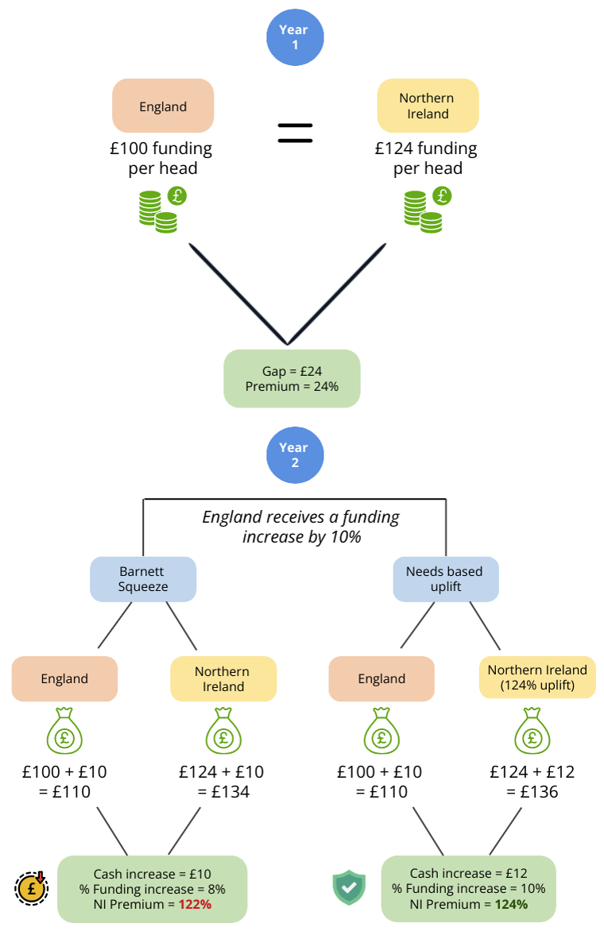
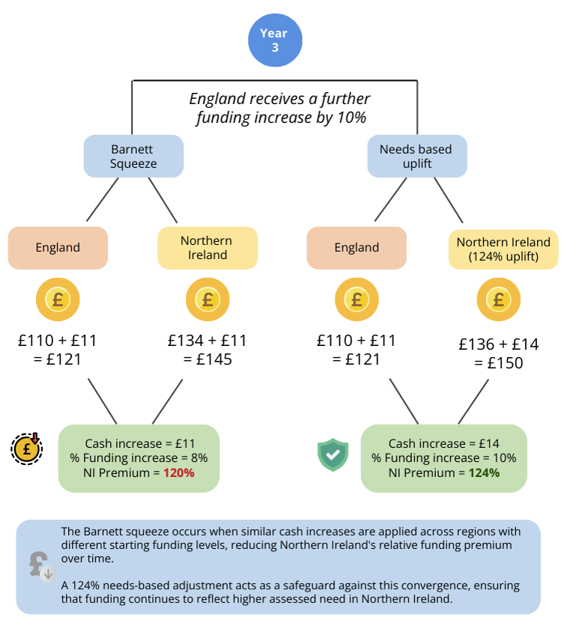
The way this is done means that differences in funding per head tend to converge over time. Where spending per person is initially higher than in England, broadly similar cash increases per head result in a gradual reduction in the relative funding premium. This process is commonly referred to as the Barnett squeeze.
The Barnett squeeze has been a longstanding feature of the funding system. Our Sustainability Report 2022, first drew attention to the implications of this process warning that NI’s funding premium could gradually erode over time in the absence of mechanisms that explicitly take relative need into account.
NI has historically received higher levels of funding per person than the comparable level of spending in England. This funding premium ranged from 38.2 per cent to 26.5 per cent over the last decade. However, Barnett-based allocations alone declined to 21.5 per cent in 2022-23, falling below NI’s assessed level of need of 24 per cent. This helped provide rationale for the introduction of a needs-based factor in 2024.
Chart 1 – NI’s funding premium (%) since 2016-17 (extract from NIFC’s assessment of the Finance Minister’s proposed 2026-27 to 28-29/29-30 Budget, page 34)
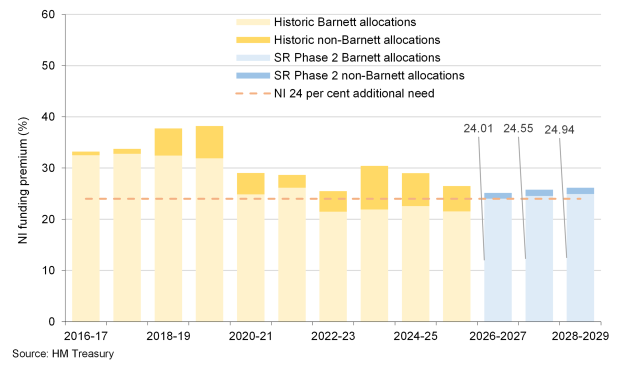
The historic spending premium over English spending is a recognition of higher levels of relative need, such as greater deprivation and the additional costs associated with delivering public services as well as the impact of the Troubles on public spending. However, these factors are not directly reflected in the operation of the Barnett Formula.
How is the Block Grant calculated?
The Executive's Block Grant comprises a historic funding baseline, adjusted each year through the Barnett Formula, alongside a smaller amount of non-Barnett funding such as City and Growth Deals and funding linked to political agreements.
The Barnett Formula determines how changes in comparable UK Government spending in England affect funding for NI. In practice, most changes to the Block Grant come through Barnett consequentials, which are calculated using a series of factors including the size of the spending change, the comparability of services, NI’s population share and, more recently, a needs-based adjustment, as shown below.
Factors used to calculate Barnett consequentials:

Barnett consequentials account for the vast majority of changes to the Block Grant, which typically finances around 90 to 95 per cent of the Executive's resource spending. As a result, increases in comparable spending in England generally lead to corresponding increases in NI’s Block Grant in cash terms. However, because the same cash increase represents a smaller percentage increase for a higher-spending system, the funding premium relative to England tends to narrow over time.
How a Needs-Based Adjustment Protects NI from the Barnett Squeeze
Why does need matter?
The Holtham Review (2010) estimated that NI required funding around 21 per cent higher than England to deliver comparable public services. The Fiscal Council's subsequent work (2023) suggested that the figure was closer to 24 per cent, reflecting updated evidence on the pressures facing public services in NI and the inclusion of devolved services such as policing and justice.
Regional Spending need relative to England (England = 100)
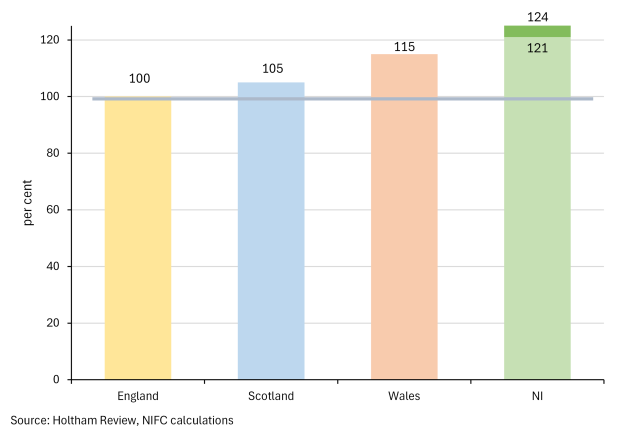
If these estimates are broadly correct, continued Barnett convergence could ultimately result in NI's funding (and that of the other Devolved Administrations, over time) falling below its relative spending need. The introduction of the Interim Fiscal Framework in 2024 was intended to address this risk.
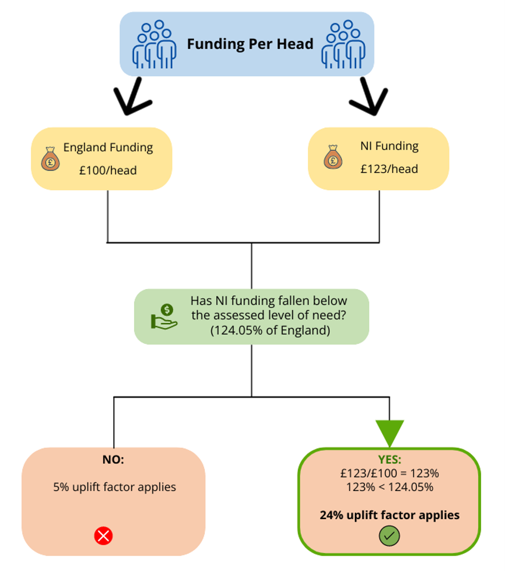
Under the new arrangements, NI’s funding is assessed against comparable spending in England at fiscal events. If funding is assessed to be below 124.05 per cent of the English level, a needs-based factor is applied to future Barnett consequentials, increasing them by 24 per cent relative to the standard Barnett calculation. If funding remains above the threshold, a transitional 5 per cent uplift applies instead. The mechanism therefore does not provide an automatic uplift to the Block Grant itself. Rather, it is designed to prevent NI’s funding from drifting below its agreed level of relative need and to keep funding broadly aligned with assessed spending needs.
NI funding premium scenarios
This chart shows how NI’s funding per head is assessed against its estimated level of need. When funding falls below the benchmark of 124.05% of England's level, an additional funding uplift applies.
How does NI compare with Scotland and Wales?
The introduction of the uplift factor has not dispelled concerns the NI’s remains unfairly underfunded, with those making that argument focusing less on appending relative to estimated need and more on how NI compares with the other devolved administrations.
Recent analysis in our Sustainability Report 2026 indicated that Scotland and Wales are funded above their level of need while NI is funded slightly below its assessed level of need. We estimate that it would take approximately £170 million to restore NI’s funding to its assessed level of need.
Premium of spending per head above England compared to need
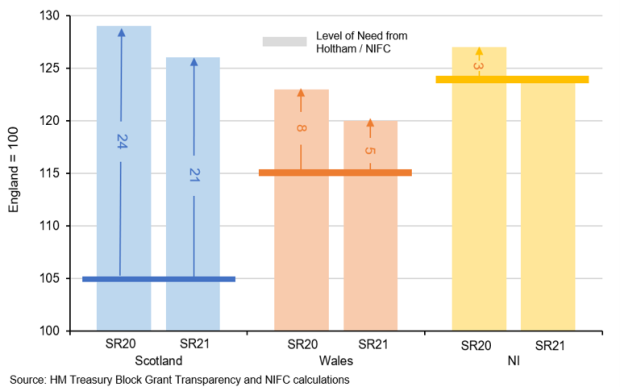
The effect is most pronounced in Scotland, where funding per head remains substantially above assessed need (although that assessment was some time ago). Wales and NI are funded much closer to their estimated levels of need than Scotland. This is consistent with the introduction of funding arrangements that explicitly recognise relative need and seek to prevent funding converging significantly below assessed need. The chart also shows that the funding premium narrows between SR20 and SR21 across all three devolved governments, illustrating the continuing effect of the Barnett squeeze, under which spending per head gradually converges towards the level in England over time. In NI, funding per head was around three percentage points above assessed need in SR20, falling to less than one percentage point in SR21, suggesting a much smaller funding premium than in Scotland.
This evidence, at least in a narrow mathematical sense, broadly supports recent claims by the First Minister and Finance Minister that NI's position differs materially from that of Scotland and Wales.
What would equivalent treatment mean?
If Scotland and Wales are funded above need, what would it mean for NI if it received equivalent levels of funding above need?
Analysis using several different methodologies suggests NI could receive around £1 billion to £1.2 billion more annually if funded on a basis comparable to Wales. In NI terms, this is a substantial sum, equivalent to 3-4 % of the Executive's annual spending power or roughly the annual budget of the department of Infrastructure. Around £3 billion to £3.5 billion more annually if funded on a basis comparable to Scotland. This would be transformative, amounting to around one-tenth of the Executive's resource budget and significantly increasing the resources available for public services.
The fact that Scotland and Wales may receive funding above their assessed levels of need raises questions about the consistency of the current funding framework. However, it does not necessarily follow that NI should also receive funding above need. An alternative interpretation is that funding across all devolved administrations should move towards levels that more closely reflect assessed relative need.
The analysis therefore highlights a broader policy choice: whether fairness is best understood as providing comparable levels of funding above need across the devolved administrations, or as aligning funding more closely with underlying measures of need.
The bigger question
The debate surrounding the Barnett Formula raises a fundamental question: should devolved funding be determined by historical allocations or by relative need?
Looking ahead, this question may become more prominent as the new Prime Minister pursues a wider devolution agenda. Before entering office, Andy Burnham, a longstanding advocate of greater devolution, argued that "growth cannot be ordered from the top down. Instead, it can only be nurtured from the bottom up", reflecting his view that decision-making should be shifted away from Westminster. While the Government's initial devolution proposals are focused on England, a broader move towards decentralisation could prompt renewed scrutiny of how funding is distributed across the UK. In turn, this may raise questions about whether existing funding arrangements remain fit for purpose and adequately reflect the differing needs of the UK's nations and regions.
One limitation in discussions of the Barnett squeeze is the availability of up-to-date data on NI's relative funding position. While the UK Government publishes the methodology used to calculate relative funding levels and periodic estimates as part of Spending Reviews, there is no regularly updated official series showing the precise size of NI's spending premium relative to England in each year. As a result, assessments of whether NI is moving closer to, or further from, its assessed level of need inevitably rely on published estimates and projections rather than a definitive real-time measure.
Recent discussion has been shaped by HM Treasury's Open Book Review, which argues that NI has been funded above the 124 per cent needs threshold throughout the current Spending Review period. By contrast, our estimates suggest a slightly lower figure of around 123 per cent in 2026-27, with much of the difference reflecting the population assumptions used. This highlights how assessments of relative funding can depend on the methodologies and assumptions used.
The significance of the Interim Fiscal Framework extends beyond its immediate impact on NI’s finances. Its key innovation is not that it permanently increases funding, but that it introduces a mechanism designed to prevent NI’s funding position from falling below its assessed level of need as Barnett convergence continues. More broadly, the Framework has renewed debate about how relative spending need should be measured across the UK.
The introduction of the 124 per cent needs-based factor funding floor therefore represents a significant development in NI’s funding arrangements. More broadly, it contributes to an ongoing debate about the role of need within the UK's system of devolved finance and the extent to which future funding arrangements should reflect relative spending requirements rather than historical funding patterns.