
The return of multi‑year budgeting at the UK level could have marked a turning point for the Northern Ireland Executive, providing a chance to take stock, set longer-term priorities, and plan sustainably over the multi-year period. Instead, we have seen some rather familiar problems: entrenched overspending, rising pay pressures, and limited fiscal flexibility. On top of that, political disagreements remain over the content of the Finance Minister’s proposed budget.
The Council has undertaken an assessment of the Draft Budget for 2026‑27 to 2028‑29/29‑30, as we are required to do annually. This reveals a plan that, while balanced on paper, risks unravelling in practice.
In this article, we unpack these tensions — drawing upon our recent publication — to explore what is at stake in this Budget, and where the Executive may need to show more resolve than it has done to date.

image generated by Microsoft copilot
1. The Treasury Loan Softens the Blow — but risks normalising overspending practices
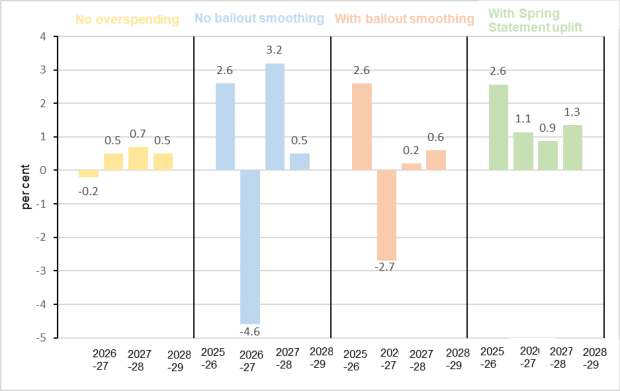
In recent years the Executive has found it challenging to live within its means. Departments are on track to overspend by around £450 million in 2025‑26, with Health and Education the chief contributors. To plug this gap, the Treasury stepped in with a £400 million “loan”, which they agreed could be repaid over three years (rather than in the following fiscal year which strictly following the Treasury rules would requiree). This smooths the sharp drop in funding that would have followed the end of the £520 million restoration package, pushing some of the pressure into later years.
In essence, this functions as a de facto bailout. The Treasury is offering major support with quite limited conditionality – only the condition that the Executive signs up to an open book assessment of NI departments’ spending. Each time this happens, it signals that the UK Government may step in again, which weakens the incentive for the Executive to take difficult, but needed, decisions on revenue, workforce size, and how to manage pay pressures. If a department can overspend in the knowledge that the Treasury might step in late in the year, what incentive remains for rigorous in‑year financial management?
These repeated interventions—support packages, Reserve access, loan write‑offs—ease short‑term pain but also risk making overspending routine. Instead of fixing the gap between what NI spends and what it can afford, each bailout delays the need for real change and raises the risk that overspending becomes habitual.
The Treasury’s Statement of Funding Policy says that overspending against available budgets by the devolved governments constitutes “serious financial mismanagement”. By accommodating “mismanagement” there is a danger of Treasury normalising it.
2. A Budget balancing act that works on Paper — but not in practice
Looking at the fiscal plans at the time, the Minister’s Draft Budget met the legal requirement to balance projected spending with available funding. Departments are allocated what the Block Grant, Regional Rates, borrowing powers and anticipated external funds can support.
But these formal balances disguise deeper issues. Three stand out:
(i) The overspend repayment of £400m had not yet been applied at the time of the Draft Budget
The Minister’s published tables do not factor in the £80 million repayment of the Reserve claim required in 2026‑27 — nor any further deductions should the current‑year overspend exceed £400 million. Furthermore, the Spring Forecast confirmed that the Executive will receive an additional £380 million in resource DEL over the next three years — with the profile heavily front‑loaded: £227.8 million in 2026‑27, just £5.6 million in 2027‑28, and then £144.9 million in 2028‑29. This uplift is almost entirely driven by increased spending in England on special educational needs, which generated large Barnett consequentials for NI. This also has not been included.
Once those are applied, the 2026-27 cliff-edge is eliminated, however the baseline beyond that becomes substantially tighter than it appears in the Draft Budget.
Chart 1 - Real-terms change in Block Grant on previous year under four scenarios
Source: Department of Finance
(ii) The Budget assumes pay pressures can be absorbed
Public sector pay is the single biggest structural pressure facing NI. The Barnett formula does not automatically fund pay parity with England, and NI’s public sector is larger than England’s relative to its population. Matching pay increases in England therefore costs NI more than it receives in Barnett consequentials.
Yet departments that are already overspending are expected to absorb another round of pay awards within flat (or even reduced) real‑terms allocations.
(iii) Departments begin from a position of in-year instability
Health and Education — the two biggest departments and the two biggest overspenders — enter 2026‑27 with lower opening allocations than their 2025‑26 final spending levels. If these services cannot live within budget now, it is difficult to see how they could do so next year with less.
The result is a Budget that balances ex ante but is unlikely to do so ex post. Without substantial course correction, overspend pressures will likely re-emerge early and repeatedly.
3. A multi‑year Budget — a missed opportunity?
It has been over a decade since NI last set a multi‑year Budget. In theory, this is a moment rich with opportunity:
- longer-term visibility
- space for genuine reform
- scope to prioritise strategically
- the ability to make transformational decisions rather than in‑year crisis interventions
However, the proposed Budget signals little appetite for strategic change.
i. Allocations largely roll forward previous patterns.
Once earmarked and pre-committed spending is accounted for, the Budget largely preserves the status quo, rolling forward baselines in a “politically neutral” way. Departments receive broadly the same shares they have held in recent years, and very limited headroom remains for policy choice, particularly in 2026‑27. This suggests no significant strengthening of the link between spending plans and delivery of Programme for Government priorities, compared to the previous year.
ii. Bids far exceed available resources
Departments collectively bid for almost £2.7 billion in additional resource funding for 2026‑27; only around £115 million was available. Health alone bid for over £1.1 billion — receiving just £63 million. This mismatch is not new, but it is starker this year because the opening baseline is already so tight.
iii. Earmarked funds limit flexibility
In several departments (notably Agriculture, The Executive Office and Finance), 40–60 per cent of allocations is earmarked for specific schemes — leaving little room for discretion.
iv. Political division clouds the path to a Final Budget
All major Executive parties except the Finance Minister’s own have rejected the proposals. Without agreement, NI would head towards a new financial year with no Budget in place — a situation not without precedent but one that adds operational risk and complexity.
Multi‑year budgeting could have marked a fresh start. Instead, it risks becoming another exercise in managing inherited pressures rather than reshaping them.
4. Pay parity as a significant structural pressure
Public sector pay is the dominant structural challenge facing NI’s finances.
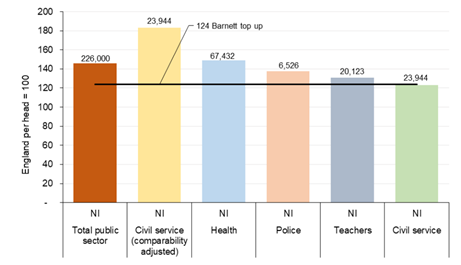
NI has a larger public sector workforce per head than England. In health, teaching, policing and the civil service, NI has more staff per capita than England. This reflects service design, geography and historical choices — but it has fiscal consequences.
Chart 2 – NI public sector workforce per head compared to England
Source: DE (NI), DE (UK), PSNI, Home Office, DoH, NHS England, ONS
Barnett delivers funding based on population shares, not workforce size. Therefore, Barnett does not fund parity.
When the UK Government agrees, for example, a 5 per cent increase in public-sector pay in England, NI receives only the population-share equivalent uplift. This is insufficient to match the cost of applying that same 5 per cent rise to a significantly larger workforce. The Block Grant does not rise enough to match this in NI under the Barnett Formula – even with the new 24% top-up. Affordability issues therefore arise in sectors in NI where there are more than 24% more employees compared to England.
Take Health, for example. Going into 2026‑27 its opening budget would be lower than what was spent in 2025‑26. At the same time, staff are due a 3.3 per cent pay rise recommended by the NHS Pay Review Body, a change the Department of Health estimates will cost around £120 million next year alone. However, NI’s health service employs 49 per cent more staff per head of population than England yet funding only increases in line with population, not workforce size. NI therefore doesn’t receive enough extra money in the Block Grant to cover the cost of matching pay awards across such a large workforce. The result is a widening structural gap: every time NI matches England’s pay increases, costs rise permanently, but the funding doesn’t. Health carries past pay decisions into future budget years and, if it is to meet pay parity it must choose between cutting services or staff, or to hope for funding to be made available from elsewhere in the system.
In addition to this, pay awards are cumulative and each year’s uplift compounds. Agreeing to match England’s increases in one year bakes higher pay costs into all future years.
The Executive’s commitment to maintaining parity is understandable, but as we noted in our report, the choice to maintain it implicitly creates a second choice - how will the cost be met?
If additional revenue is not raised and/or staff numbers are not reduced, the pressure falls squarely on service budgets.
Pay is not a one-off problem. It is a structural gap that will continue to widen unless addressed with structural solutions.
5. Capital Constraints
The capital position remains highly constrained, with most funding already tied up in contractual and policy commitments and very limited flexibility to reprofile spending, while overall Capital DEL is broadly flat in real terms across the Budget period. The absence of an agreed Investment Strategy, still under consideration by The Executive Office, means capital plans continue to be set ahead of strategic direction, weakening alignment and prioritisation. FTC also remains difficult to deploy—restricted to loans or equity in private entities—resulting in recurring underspends and limiting its usefulness for core public‑sector investment
6. Conclusion
The Draft Budget and the policy decisions surrounding it reveal a system that is still leaning heavily on short‑term fixes.
Treasury support, including the latest loan from the Reserve (alongside the recent Barnett uplift), has again softened what would otherwise have been a sharper fall in funding. But it acts as a de facto bailout and could incentivise the wrong fiscal behaviours. The combined actions of the Executive and the Treasury risk normalising overspending, weakening fiscal discipline, and making it harder to return to a sustainable path.
Although the Budget balances on paper, the reality is less stable. With political disagreement persisting, the chance of entering the new year without an agreed Budget remains real.
Looking further ahead, the Executive and the UK Government face a choice: continue relying on just in time bailouts or confront the structural pressures that have been allowed to build. Sustainable public services will require decisions that go beyond temporary relief—decisions on revenue, workforce, and priorities that cannot be postponed indefinitely.